Reface, Repaint, or Replace? How to Decide What to Do With Your Kitchen Cabinets
Most of the kitchen calls we get around East Hampton start the same way: “The cabinets are dated, but I do not know if they need to go.” It is the right question, because cabinets are usually the single biggest line in a kitchen budget, and there are three very different answers. You can repaint them, you can reface them, or you can replace them. Each one is the correct call for a certain kitchen and a mistake in the others.
After twenty-plus years of opening cabinet doors in Connecticut homes, here is how we sort it out, in the same order we do it on a site visit. One thing to know up front: Magee Homes replaces cabinets. We do not paint or reface them. That is exactly why we will tell you straight when painting or refacing is the right answer, because in that case we have nothing to sell you.
Start with the boxes, not the doors
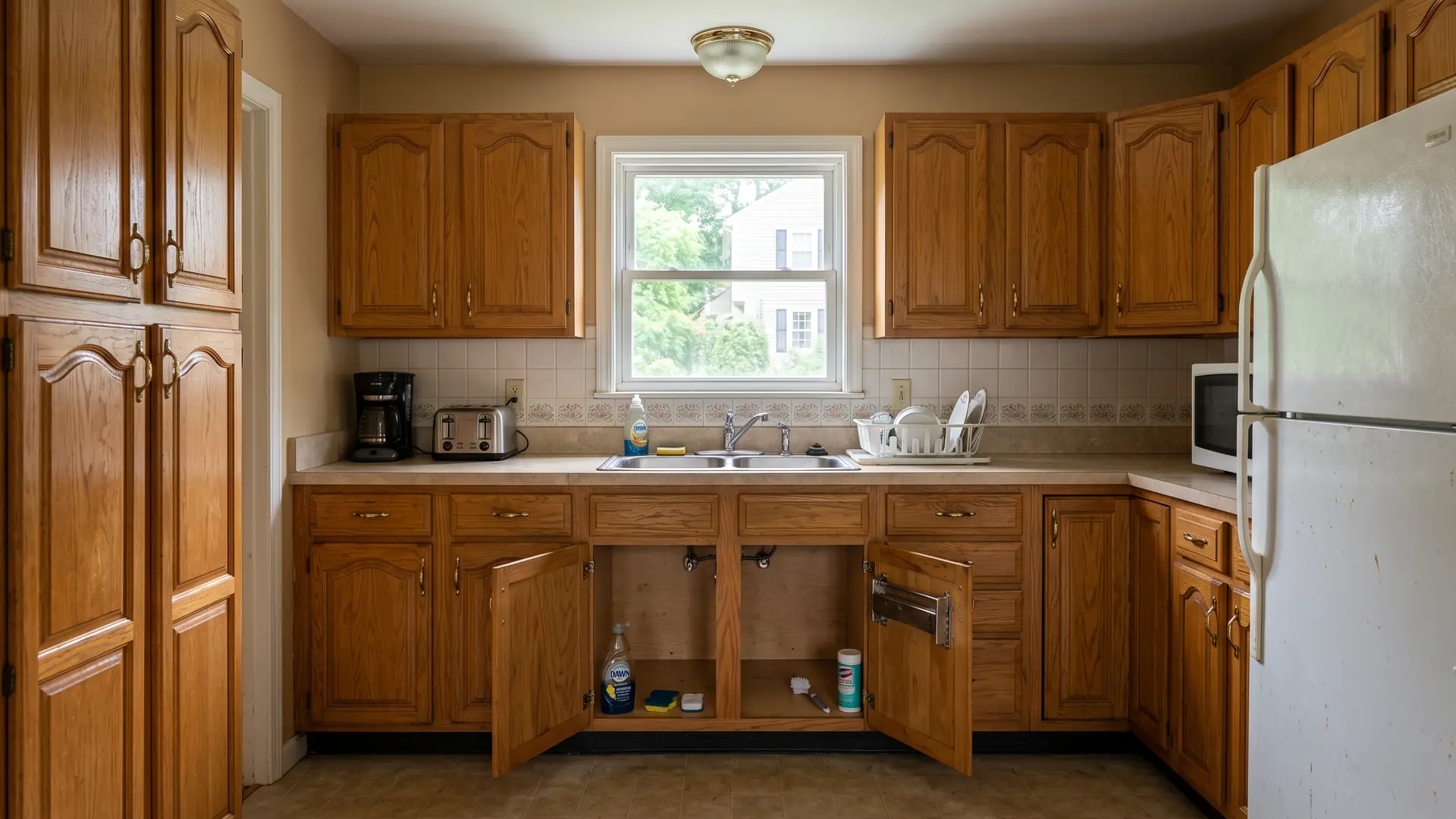
The doors are what you see, so they get all the attention. But whether painting or refacing is even an option comes down to the boxes, the part that stays screwed to the wall. Open a base cabinet, especially the one under the sink, and look at three things.
First, what the box is made of. Plywood boxes with hardwood face frames can be refinished or refaced again and again. Particleboard boxes are a different story. If the shelf edges have gone fuzzy, the bottom under the sink has swelled from a slow drip, or you can push a side panel and feel it flex, that box is done. Painting or refacing it puts new money on a structure that is failing.
Second, how the hinges are holding. Pull a door toward you and watch the hinge screws. If they wiggle in the face frame or have been re-screwed into wood filler more than once, the frame is soft. That shows up constantly in builder-grade cabinets from the 1980s and 1990s in the raised ranches and colonials around Glastonbury and Middletown.
Third, whether the layout works. Refacing and painting both lock you into the exact footprint you have today. If the real problem is a fridge that blocks a walkway or no place to put a dishwasher, no finish fixes that. We cover this in more detail in our guide to a kitchen refresh versus a full remodel.
If the boxes pass all three checks, you have options. If they fail any one of them, the honest answer is replacement, and it is better to hear that before you fall in love with a paint color.
Repainting: the least expensive option, when it is done right
Painting is the right choice when the boxes are solid, you like the door style, and what bothers you is the color or the finish. A dark 1990s stain to a clean off-white changes a room dramatically without touching a single hinge location.
Where painting goes wrong is in the prep and the material. A durable cabinet finish is not a weekend of brushing on wall paint. Every door and drawer front comes off and gets labeled. Everything is degreased, because years of cooking oil will lift a finish faster than anything else. Surfaces are scuffed or sanded, primed with a bonding primer, and finished with a cabinet-grade enamel, usually sprayed so there are no brush marks. Skip any of those steps and you get chipping around the handles within a year.
Two things to know before you commit. Oak has an open grain that telegraphs through paint. You can fill it, but it adds labor, and even then the texture is visible up close. Some homeowners like that look and some do not, so ask whoever does the work to finish a sample door first. And thermofoil or laminate doors do not hold paint well no matter how they are prepped, which usually pushes those kitchens toward refacing or new doors.
Painting is also the right answer when your timeline is short. If you are listing the house within the year, a professionally painted kitchen with new hardware shows well and keeps the money in the sale.
Refacing: new doors and a new skin on the boxes you keep
Refacing means the boxes stay, and everything you see gets replaced. New doors, new drawer fronts, new hinges and hardware, and a matching veneer or laminate applied to the face frames and any exposed box ends. Done well, it is very hard to tell a refaced kitchen from a new one, because you never see the old material.
Refacing earns its place when the door style is the problem, not just the color. Painting a raised-panel arch door still leaves you with a raised-panel arch door. Refacing lets you go to a flat shaker or slab door on the same boxes. It is also the moment to add soft-close hinges, replace worn drawer boxes and glides, and put in pull-outs or a trash cabinet insert while the doors are off. Those functional upgrades are what most people actually notice day to day.
The trade-off is that refacing costs more than painting, and if you are going to change the door style, upgrade the drawers, and add organizers, the total can get close enough to new cabinets that it is worth comparing both. When a homeowner brings us a refacing quote to compare against new cabinets, sometimes refacing wins clearly. When it is close, replacing usually makes more sense, because you also get to fix the layout at the same time.
Replacement: when it is the smarter long-term call
New cabinets are the right answer in a few specific situations, and it is not always the biggest budget that gets there.
The boxes are failing. Swollen particleboard, sagging shelves, water damage under the sink, or a face frame that will not hold a screw. There is no finish that fixes this.
The layout is fighting you. Adding an island, moving the range, opening a wall to the dining room, fitting a real pantry, or getting a dishwasher where there never was one all require new boxes. Refacing cannot move a wall.
You are already opening things up. If plumbing or electrical needs updating anyway, or you are replacing the floor, the cabinets are the logical piece to change at the same time. Doing it in one project is less disruptive than doing it in two.
You want the guts modern, not just the faces. Full-extension drawers, deep drawer stacks instead of doors and shelves, built-in trash and recycling, and proper corner solutions are far easier to get with new cabinets than by retrofitting an old box.
New cabinets also let us fix the small things that make a kitchen feel custom: filler pieces that actually line up, crown that meets the ceiling cleanly, and toe kicks that run straight on an old floor that does not. You can see the difference in the kitchens in our project gallery.
The one mistake we see most often
Putting a brand-new stone countertop on tired boxes. Quartz and granite are templated to the cabinets they sit on. Once that top is installed, the cabinets underneath are locked in place for as long as the top lasts, which is decades. If there is any chance the boxes will need to be replaced in the next five to ten years, replace them before the counter goes on, not after. We have had to break out perfectly good stone because a homeowner was told the cabinets were fine when they were not.
The same logic applies to floors. If you are replacing cabinets, the new floor usually goes in first or is planned around the new footprint. Refacing or painting leaves the floor alone. It is one more reason to settle the cabinet question before anything else in the kitchen gets ordered.
A quick way to decide
- Boxes solid, door style fine, color wrong: repaint.
- Boxes solid, door style dated, layout works: reface.
- Boxes failing, or the layout needs to change, or you are already opening walls and floors: replace.
- New countertops planned: settle the cabinet question first, every time.
What drives the cost, whichever way you go
We do not quote prices online because every kitchen is different, but the drivers are consistent. For painting, it is the number of doors and drawers, whether the grain needs filling, and how much surface is exposed. For refacing, it is the door style and material, the number of openings, and how many drawer boxes and glides are being replaced. For new cabinets, it is the construction grade, plywood versus particleboard, the door style, the interior accessories, and whether the layout is changing enough to involve plumbing or electrical work. In all three cases, older homes can add work once the old cabinets come off the wall and the plaster or drywall behind them needs repair.
Not sure which one your kitchen needs?
This is exactly what a site visit is for. We open the doors, check the boxes, look at the layout, and tell you straight which of the three makes sense, including when the right answer is a painter or a refacing company rather than us. Learn more about our kitchen remodeling services, read about who you will be working with, or schedule a free consultation and we will walk through it in your kitchen.
Kitchen Cabinet Questions
Common questions from Connecticut homeowners deciding whether to paint, reface, or replace their kitchen cabinets.
Mostly, but not completely. Oak has an open grain that shows through paint unless the surface is grain-filled before priming, which adds labor. Even with filler, a slight texture is visible up close. Ask the painter to finish a sample door first so you can decide whether you like the look before the whole kitchen is done.
Usually, yes, as long as the scope stays simple. Once you add a new door style, new drawer boxes and glides, soft-close hardware, and pull-outs, the gap narrows. When the two get close, replacing is generally the better value because you can also correct the layout. If you have a refacing quote in hand, bring it to the consultation and we will compare it honestly against new cabinets.
Refacing is typically about a week of work in the kitchen once the doors and veneer arrive, and the kitchen stays mostly usable. New cabinets involve demolition, installation, and countertop templating, so the kitchen is out of commission longer. The bigger difference is lead time, since custom doors and new cabinetry both have to be ordered before anything starts.
Yes, and it is a common combination when the boxes are solid. The key is confirming the boxes are worth keeping before the countertop is templated, because a stone top locks the cabinets underneath in place for the life of the counter.
They do when the prep is done properly: doors removed, surfaces degreased and sanded, a bonding primer, and a sprayed cabinet-grade enamel. Finishes that chip around the handles within a year are almost always the result of skipped prep or the wrong product, not painting itself.
Not for the cabinets themselves. Permits come into play when the project also moves plumbing, adds or relocates electrical circuits, or changes structure, which often happens when a layout changes. We handle the permitting and inspections with your town when they are needed.